
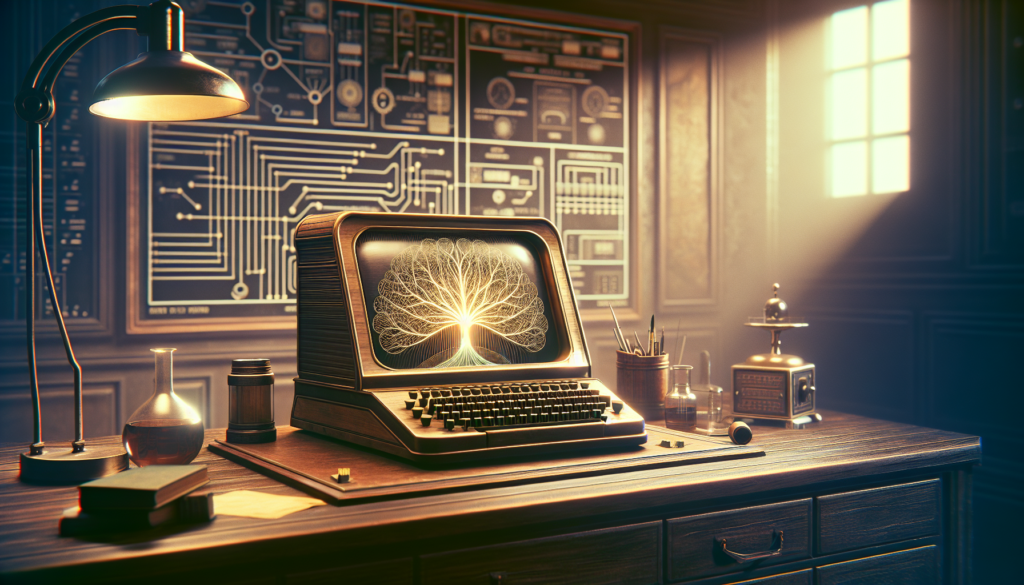
Visionary researchers embarked on a quest to replicate the nervous system inherent in living organisms. These innovators, inspired by the brain’s functionality, set out to design machines capable of processing data akin to human cognition.
The creation of the inaugural neurocomputer signified a turning point in the realm of artificial intelligence.
Pioneers like Frank Rosenblatt played a significant role in introducing the neural network concept, laying the foundation for future breakthroughs.
This groundbreaking innovation opened up new avenues in machine learning, showcasing its ability to tackle intricate challenges and influence technology’s trajectory significantly.
The Evolution Of Neural Networks
Neural networks have dramatically changed the landscape of artificial intelligence. Research into early models served as a building block for future advancements.
Initially, perceptrons showcased capabilities that laid the groundwork for complex architectures.
Data manipulation techniques were refined as scientists aimed to replicate the functionality of biological neurons.
These foundational designs not only inspired modern machine learning methods but also highlighted key milestones in neural computing evolution. Computing power surged with innovative frameworks, enabling systems to process vast amounts of information efficiently.
Understanding the principles behind these early structures allows for insights into contemporary deep learning applications and their ongoing development. Functionality within networks is rooted in these initial concepts, demonstrating their relevance in shaping today’s technologies.

Key Figures In Neural Computing
Influential personalities have significantly transformed the realm of neural computing. Geoffrey Hinton‘s introduction of the backpropagation concept changed how artificial neurons learn from data, revolutionizing technology in the process.
His foundational research laid the groundwork for current frameworks utilized in machine learning.
Yann LeCun advanced these principles with his pioneering convolutional networks, enhancing input/output processing capabilities within computer hardware.
These breakthroughs not only elevated theoretical understanding but also fostered practical applications across diverse fields. Collectively, their remarkable contributions have inspired emerging trends, facilitating future developments in computational intelligence and refining machine learning techniques.
Neural Computing Influencers
- Geoffrey Hinton’s backpropagation algorithm is a cornerstone of modern neural networks, enabling effective learning from data.
- Yann LeCun’s convolutional networks have significantly improved image and speech recognition technologies.
- The advancements made by Hinton and LeCun have led to widespread applications in fields such as healthcare, finance, and autonomous systems.
- Their work has inspired a new generation of researchers and practitioners in artificial intelligence and machine learning.
Understanding Artificial Neurons
Modern advances in neural computing are largely driven by the innovative designs of nodes, which imitate biological processes. These units receive input data, process it, and yield output through activation at specific thresholds.
The concept of a Perceptron exemplifies this functionality, operating like a light switch.
When sufficient signal strength is detected, it activates, mirroring how biological neurons transmit impulses via dendrites and axons.
Insight into these processes reflects the intricate ways artificial neurons emulate human brain behavior. The implications of their computation stretch into advancements in machine learning and AI technologies, where they contribute significantly to efficient processing and interpretation of complex data.
The Role Of Learning Algorithms
Modern systems drive advancements in artificial intelligence through the use of effective learning techniques. These algorithms empower neural networks to process extensive data arrays with remarkable precision.
Applications such as image recognition illustrate the impact of optimized learning methods.
Nathaniel Rochester’s innovative contributions set a strong foundation for these developments.
Businesses utilize algorithms to refine customer interactions, leading to smarter decision-making strategies. Backpropagation, in particular, has revolutionized training approaches, enabling artificial neural networks to learn from mistakes effortlessly.
This remarkable capability allows systems to adapt and evolve, revealing the transformative power of learning algorithms across various real-world applications.
Artificial Intelligence Advancements
- Neural networks can process large datasets with high accuracy, enhancing tasks like image recognition.
- Nathaniel Rochester’s work laid the groundwork for modern AI algorithms and their applications.
- Backpropagation allows neural networks to improve by learning from errors, significantly advancing training methods.
- Businesses leverage AI algorithms to enhance customer experiences and make informed decisions.
Exploring Feedforward Structures
Innovations in artificial intelligence have elevated feedforward networks to a prominent position within machine learning frameworks. Neural nets are designed to process data through structured layers, where each neuron computes an output based on weighted inputs.
Architectural variations introduce diverse configurations, affecting the learning efficiency of these systems.
Activation functions significantly enhance this efficiency by adding non-linearity to the learning process.
Successful implementations in image recognition demonstrate how these networks excel at interpreting visual data, while their applications in natural language processing continue to transform text analysis. Real-world deployments confirm these networks’ capabilities, providing substantial benefits across various sectors with improved accuracy and performance.
Breakthroughs In Machine Learning
Recent advancements have significantly reshaped the landscape of computational intelligence. Enhanced perceptron structures have not only increased model accuracy but also deepened understanding of various learning paradigms.
Notably, transfer learning utilizes previously trained networks, allowing new challenges to be tackled efficiently, thereby enhancing adaptability.
This technique enables an input layer to relay valuable insights acquired from prior experiences, streamlining the training process considerably.
Reinforcement learning introduces groundbreaking algorithms that adaptively refine decision-making processes by learning from interactions with unpredictable environments. Hybrid models exploit diverse strengths of various approaches, paving the way for effectively addressing intricate problems while generating more sophisticated output layers.
Computational Intelligence
- Enhanced perceptron structures improve model accuracy and understanding of learning paradigms.
- Transfer learning allows efficient tackling of new challenges by utilizing insights from previously trained networks.
- Reinforcement learning introduces algorithms that refine decision-making through interactions with dynamic environments.
- Hybrid models combine strengths of various approaches to address complex problems and produce sophisticated outputs.
How Neurons Mimic The Human Brain
Replicating the functionality of biological components, artificial neurons perform vital tasks in advanced systems. Neural networks utilize designs inspired by physical structures found within the human brain.
This interconnect between artificial and biological systems enhances input and output efficiency, allowing for streamlined processes.
IBM highlights the significance of these connections in executing complex functions, including language processing tasks.
The principles behind unsupervised learning empower these models to adapt, closely resembling cognitive behaviors observed in humans. Analyzing how these clusters of neurons influence decision-making presents opportunities across multiple fields, particularly within brain-computer interfaces.
Insights gained from this mimicry facilitate developments in innovative technologies, enriching applications in cognitive computing.
The Impact Of Deep Learning Techniques
Revolutionizing various industries, deep learning techniques enhance the overall functionality and efficiency of neural networks. Convolutional neural networks are pivotal in promoting advancements in image recognition and processing capabilities.
Businesses utilize deep neural networks for improved data analytics, delivering real-time insights that inform strategic decision-making.
Pattern recognition through these models enables organizations to assess consumer behavior with unprecedented accuracy.
The healthcare sector reaps substantial benefits, with systems diagnosing complex conditions at speeds that exceed human specialists. For instance, a case study highlights how a deep neural network model successfully identifies early signs of diseases, leading to timely interventions.
As industries integrate this innovative technology, the transformative effects of deep learning will continue to expand, inspiring innovation and efficiency across diverse fields, including autonomous driving.
Applications Of Neural Networks
Across various industries, neural networks facilitate innovative solutions for complex challenges. In healthcare, models like trained networks enhance disease prediction and support personalized medicine approaches.
Transportation systems leverage advancements in image recognition, enabling safer autonomous vehicle navigation.
The finance sector increasingly relies on gradient descent algorithms to optimize algorithmic trading strategies and refine risk assessments.
Climate modeling employs these networks to predict and simulate environmental changes with higher accuracy. The creative arts capitalize on these technologies, fostering unique content generation and style transfer capabilities.
These diverse applications underscore the transformative impact of artificial neural networks across multiple domains.
The Future Of Artificial Intelligence
Emerging technologies promise to revolutionize how society interacts with sophisticated systems. Innovations, driven by machine learning algorithms, are transforming industries like healthcare and finance.
Contributions from early visionaries such as Frank Rosenblatt, who created the perceptron, set the foundation for today’s advancements.
These breakthroughs enable enhanced object recognition and data processing, reshaping operational dynamics across various sectors.
The integration of AI into daily life is substantial, leading to shifts in productivity standards. Ethical implications surrounding privacy and autonomy are paramount as societies incorporate these transformative technologies.
As developments progress, it’s essential to consider their societal impacts and ensure responsible use in our increasingly interconnected world.
Emerging Technologies
- Machine learning algorithms are being widely adopted in sectors like healthcare for improved diagnostics and personalized treatment.
- Frank Rosenblatt’s development of the perceptron laid the groundwork for modern neural networks and deep learning techniques.
- Enhanced object recognition capabilities are being utilized in various applications, from autonomous vehicles to security systems.
- The integration of AI raises significant ethical questions regarding privacy, data security, and the autonomy of individuals.